Due Dilligence (DD)
2026-10-20 Academic
Designed by Freepik - Magnific.com
What are you actually buying when you purchase a commercial property??
A commercial building may appear well-maintained while still having deficiencies related to fire safety. Before a purchase or sale, the parties involved should familiarize themselves with the building’s technical condition, its fire safety, and the associated documentation. This provides a better basis for assessing risks and the investments required to rectify any faults or shortcomings.
Briefly explained
Technical due diligence of commercial real estate involves an assessment of a building’s technical condition in connection with its sale. A fire safety assessment can determine whether the actual and intended use, safety measures, and documentation are in order. The scope of this review is agreed upon by the buyer and seller, and the findings may influence decisions regarding further investigations, remedial measures, pricing, and contractual terms.
What is technical due diligence?
The scope is determined by the size and complexity of the building, as well as the required level of detail for the assignment. A technical review may cover structural elements, installations, building operations, and planned modifications. The objective is to identify factors that could impact the building’s use or associated costs. NS 3424 ↗ provides a methodology for assessing condition; however, the specific commission must define what is to be examined and the criteria against which the building is to be evaluated.
A fire safety condition analysis is a more specialized, focused assessment of fire safety. It can be conducted in accordance with the methodology set out in the Byggforsk series (Data Sheet 720.306, Fire Safety Condition Analysis), examining current premises, the building’s actual use, documentation, and observable non-conformities. Such a fire safety condition assessment does not replace inspections of electrical systems or reviews of other technical aspects of the building.
What should be examined in the electrical installation?
An older or heavily loaded electrical installation may require maintenance and investment. A buyer should therefore request information regarding capacity, distribution boards and protective devices, modifications made, previous non-conformities, and documentation. For new installations or modifications, declarations of conformity and associated documentation are particularly relevant. Electrical thermography may be appropriate as a specific diagnostic tool when the nature of the assignment warrants it.
NEK 405-3 ↗ applies to electrical inspections in commercial properties. NEK 405-20 covers, among other things, the assessment of costs required to bring an electrical installation to a defined standard. An “electrical condition report” should therefore be accompanied by a precise description of the methodology and scope. None of these inspections are equivalent to a fire safety condition analysis. Penetrations through fire-rated partitions and changes in building use may require a specialized fire safety assessment.
What should be examined before handover?
- Fire safety documentation: Building permit files, fire safety concepts, subsequent alterations, other documentation regarding the level of fire safety, and fire safety drawings. The absence of a fire safety concept does not automatically mean that the building is non-compliant or illegal.
- Fire safety review of the building: This is based on documentation received from the seller, any additional documentation obtained, and findings made during the site inspection.
- Electrical installations: Relevant documentation, inspection reports, modifications, non-conformities, capacity, and potential remedial measures—all assessed by qualified electrical professionals.
- Safety measures: Fire separations and penetrations, escape routes, fire alarms, sprinkler systems, and guidance systems where such measures are required. Verify that the installation aligns with the building’s use and the documentation received.
- Operation and internal control: Reports on inspections and maintenance, outstanding non-conformities, division of responsibilities with users, and procedures for systematic safety management.
When bringing in new tenants or considering a change in use, it is advisable to examine the approved usage and fire safety requirements. A change in use may trigger a requirement for a formal application and compliance with current building regulations ↗.
Are you planning to purchase commercial property?
PiD Solutions can provide a fire safety review of both the documentation and the building itself, helping to clarify key issues that should be addressed prior to handover.
What could deficiencies cost after handover?
A non-compliance issue does not necessarily result in a major expense. However, findings indicating such issues may necessitate updates to documentation or physical remedial work. Potential costs must be identified, investigated, and estimated before being incorporated into the investment plan during the property acquisition or divestment process.
What does this mean for the buyer?
A documented review makes it easier to distinguish between matters that require immediate attention during a transaction and those that can be investigated further—such as planned maintenance.
As part of the due diligence process, the buyer will use the findings from the condition assessment to evaluate the property’s value, necessary future investments, risks, pricing, contingencies, and contractual terms.
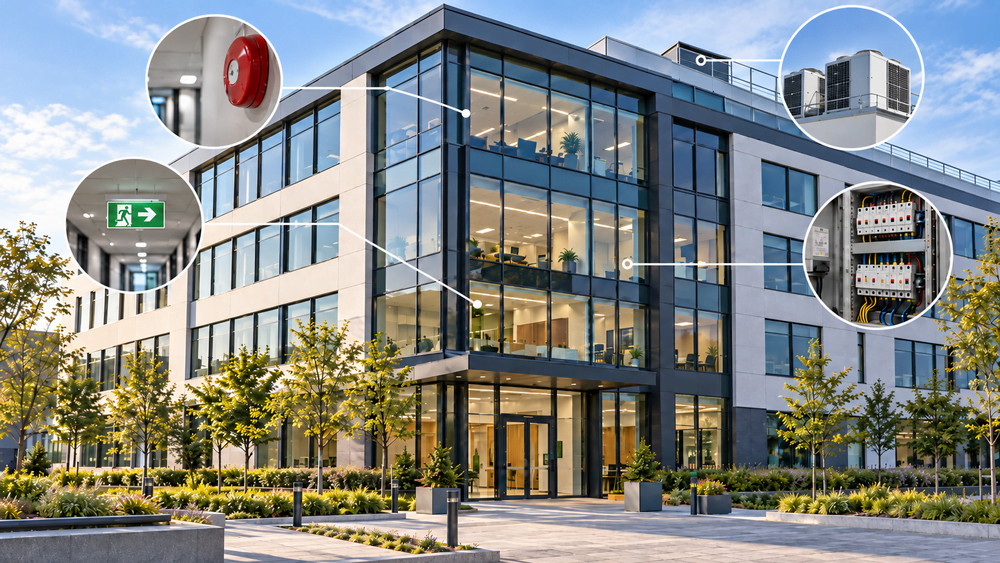
Image was created using AI.
What does this mean for the seller?
Before the sales process begins, the seller should assess the property’s status by gathering building-related documentation and reports, identifying and clarifying any non-conformities, and evaluating potential remedial measures. Thorough documentation can help make the buyer’s inquiries more specific and the overall process more predictable. The goal is to provide an accurate picture of the building; even when issues requiring future rectification are discovered, maintaining transparency is essential for fostering a sales and purchase process built on trust.
The new owner also assumes responsibility
The owner of a building is responsible for knowing the fire safety requirements and ensuring that safety systems are inspected and maintained. Businesses that own buildings must work systematically and document that these obligations have been met. For older structures, the Regulations on Fire Prevention may require upgrades to fire safety ↗, provided such measures are practical and economically reasonable. The required level of safety must be assessed on a case-by-case basis, taking into account the building’s age and intended use; the TEK17 building regulations do not automatically apply in their entirety upon a change of ownership. Balancing fire risk against costs—and determining the owner’s responsibility for upgrades—can be technically complex to document for regulatory authorities. Ideally, such matters should be addressed during the due diligence phase of the transaction, where any non-conformities are identified and the parties agree on who will bear the associated financial consequences. Ownership obligations are not the sole determinant of the financial liabilities parties may have toward one another regarding past circumstances. In the wake of property sales, this has frequently led to legal disputes—often because insufficient care was taken to identify and clarify responsibility for fire-safety defects or deficiencies during the transaction process.
How can PiD Solutions AS assist?
PiD Solutions AS offers fire-safety consulting, condition assessments of fire safety in existing buildings, risk analysis, and support with fire-safety documentation. A professional fire-safety review can compare documented design assumptions against actual usage, identify non-conformities, and provide a basis for prioritizing further investigations and remedial measures. Are you planning to sell or purchase commercial property? Contact PiD’s consultants to clarify what a fire-safety condition assessment should entail.
FAQ
An agreed technical assessment carried out before a sale, with the scope tailored to the building and the decision to be made.
Key areas include approved use, the building's technical systems, fire safety, documentation, outstanding non-conformities, and maintenance or investment requirements.
To establish the level of fire safety, identify gaps in the documentation, and plan any necessary investigations or remedial measures, including the costs of resolving identified non-conformities.
Relevant building permit applications and approvals, fire safety strategies or other documentation describing the level of fire safety, drawings, documentation of modifications, inspection reports, and an overview of outstanding non-conformities and procedures.
The building owner is responsible for the duties set out in the Norwegian Regulations on Fire Prevention. Users also have their own duties under the same regulations. Any claim between the buyer and seller must be assessed in accordance with the agreement and the rules applicable to the sale.
Yes. Documented findings may inform the parties' assessments and negotiations. The outcome depends on the significance of the findings and the terms agreed by the parties.
Sources (Norwegian)
- DSB - veiledning til forskrift om brannforebygging ↗
- DSB - forskrift om elektriske lavspenningsanlegg med veiledning ↗
- Direktoratet for byggkvalitet – kapittel 11 sikkerhet og brann ↗
- Direktoratet for byggkvalitet – bruksendring ↗
- NEK – 405 serien ↗
- Standard Norge – tilstandsanalyse med NS 3424 ↗
- TEK 17 – kapittel 17 ↗


