Ice fountains and acoustic panels
2026-02-05 Academic News

Anders Arnhus
Senior consultant at PiD Solutions AS
In light of the tragic fire in a nightclub in Switzerland, I have wondered whether something similar could happen here in Norway. The conclusion is that it could happen, and that there is a small probability that a rapidly growing fire could occur and put many people at risk.
When I refer to the probability as “small”, it does not mean that it is negligible; only that it is unlikely that exactly you will be affected.
This can be compared to the lottery: the probability of becoming a lottery millionaire is small, but still someone wins.
Low probability is not the same as low risk
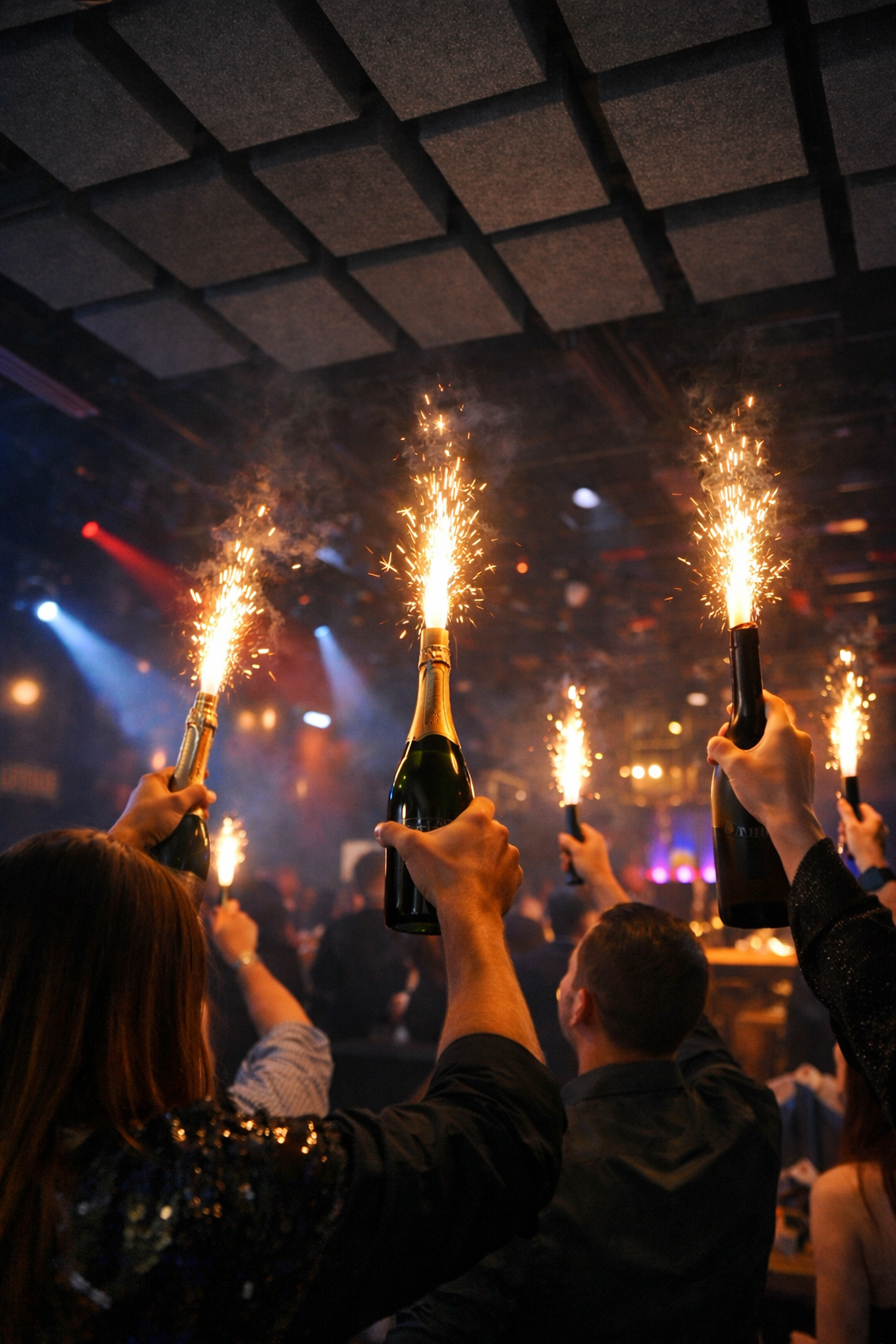
To construct a “case” for what could happen, it is relevant to look back at the fire in Switzerland. When we see the pictures from the incident, it is easy to point out the obvious. Ice fountains, also called ice torches, which in Norway are classified as fireworks in category F1, class 1, appear to have ignited something easily flammable nearby.
Category 1 fireworks are defined by the Norwegian Directorate for Civil Protection (DSB) as follows:
Category 1: fireworks associated with low risk and minimal noise level, intended for use in physically confined areas, including fireworks for indoor use in homes. Age limit 12 years. Can be used all year round.
This is basically a product that the authorities have assessed to maintain a satisfactorily low risk level when used as intended. Normally, ice fountains are marketed in Norway with a burning time of between 30-60 seconds, but ice fountains that are marketed with an extra long burning time can last up to 90-100 seconds.
In the event of unfortunate placement or use, this is more than enough heating time to ignite flammable surfaces and materials. It is reasonable to assume that this is what happened in Switzerland, and it could happen again.
When small choices have big consequences
To avoid or reduce the occurrence of such unwanted ignitions and subsequent fires, the building regulations impose requirements for the surfaces and claddings of buildings. These must not easily be ignited, contribute to the development of a fire or spread a fire.
If ignition nevertheless occurs, the materials must not produce a lot of smoke, cause rapid fire development or form burning droplets.
The building regulations thus have requirements that contain a margin which should ensure that minor erroneous conduct will not have major consequences. If you follow the requirements set by the authorities, everything should go well.
When acoustic measures undermine fire safety
However, the precursor to things not going well can be as follows. To solve challenges with bad acoustics and “too much sound” in a social venue, the owner or tenant wants to find a simple solution. A quick online search for “acoustics and sound problems” yields a large selection of products, several of which have the same appearance as what we see in the pictures from Switzerland.
One example (I have no information about this being the product that was used) is a polyurethane foam mat with tape attached to the back for easy installation.
It is typically intended for use inside a confined volume that holds noisy machinery (however, care must be taken here too, that the machinery does not pose any particular ignition hazard). It is not intended for use on surfaces in public areas. The supplier states that the product has “Fire resistance: M4”. It sounds reassuring that it has some kind of fire resistance classification.
However, another supplier of the exact same product describes it as follows on its website:
“Sound foam fire resistance: M4 (highly flammable)”.
Since “M4” is not a classification we normally use in Norway, it needs to be investigated further. A simple search gives the following description of “M4”:
- Combustible and highly flammable materials
- Droplets and flaming particles persisting for more than 10 seconds
Translated into Norwegian terms, a product in class M4 would at best achieve class E-s3, d2, which is not particularly attractive for installment in buildings. A quick search on Norwegian websites shows the same product marketed with reference to “Fire M4 / UL94”, i.e. classifications that are not included in Norwegian building regulations or building standards.
The product is nevertheless marketed on the Norwegian website as a noise-reducing measure, perfect for use in ventilation systems and for engines, with excellent sound attenuation and easy installation.
For anyone looking to solve an acoustic problem, it may be a quick fix to order and install such documented products. It is easy to order, delivered within a few days, it is easy to install, and it works as a sound-dampening product.
The point here is that it is easy to make decisions that are intended to solve a specific problem, but which at the same time introduce a major risk that one is not aware of. When it comes to rapidly developing fires in discos and nightclubs, there are unfortunately far too many tragic examples around the world. Choices that were supposed to solve an acoustic problem, but which at the same time resulted in fire safety being degraded. Not out of ill will, but out of ignorance.
Good regulations are of little use without proper practice
It may be tempting to think that the building regulations and fire prevention regulations in other countries, where they have experienced tragic fires in nightclubs, shopping malls, hotels, etc., are worse than our Norwegian regulations. We should be hesitant in claiming such. Most countries have national regulations that basically provide good provisions for fire safety. The decisive thing is how these regulations are complied with, especially in the operational phase of the building. This is where day-to-day fire safety is decided. Those responsible for operation and ownership must therefore look carefully at their own operation, there is no one else to point to.
Back to the ice fountains
There should be room to use such things on special occasions. I still don’t think it’s something I would want to set off at home in my apartment, for that the room volume and ceiling heights are too small. In venues with good ceiling height, good surfaces and claddings, and good control of the operation of the fire alarm system it can go well. But I would point out that there is a risk in starting such a flare that can last up to 90–100 seconds even in a building with heightened fire safety. It can go wrong if the flare comes loose or the host/user trips, and the flare ignites other flammable materials, clothing or furniture for the rest of its 100-second lifespan.
Responsibility cannot be delegated
It is particularly important that the owner of buildings used for gatherings communicates the fire safety requirements for the building and the premises to the users in such a way that they can easily understand it. Based on this information, they should be able to decide whether they can take responsibility for implementing simpler measures themselves or not, such as trying to improve the acoustics in the room. If they cannot decide this themselves, they must know who to ask, for whether the measures, which they are planning for various reasons, are actually fire-technically safe to implement.
We have skilled fire consultants who can assist with such assessments, and help ensure that necessary measures are implemented in a safe and regulatory manner. Please feel free to contact ↗ us for a chat.